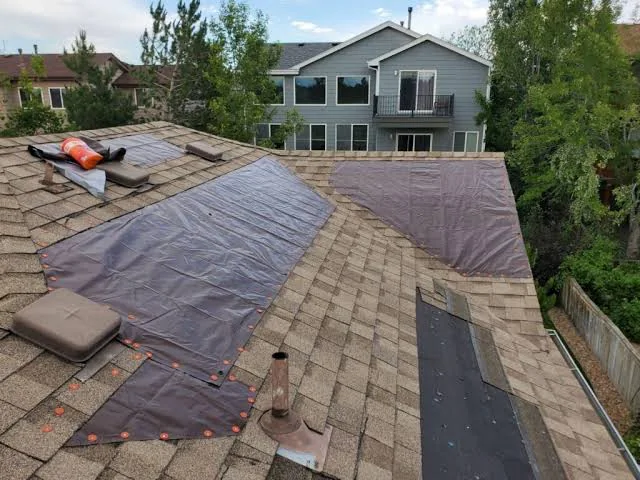
Why roof leaks matter in South San Antonio
ZIP codes 78211, 78214, 78221, 78223, 78224, 78225, 78226, 78235 cover the Southside, Palo Alto Heights, Columbia Heights, Mission San Jose, Buena Vista, Terrell Wells, Berg's Mill, Hilltop, Southton, Palm Heights and Brooks City Base. Most of the housing is single-storey and mid-century, built on flat, open ground south of the city centre.
The defining roof problem here is the transition. Houses of this era and this part of the city were very often extended afterwards — a carport, a covered patio, an enclosed porch, a back room added across a decade. Those additions were built low-slope or near-flat and tied into the original pitched roof wherever they happened to land. Every one of those junctions is a point where two completely different roofing systems have to be made watertight against each other, and it is the single most common leak point on south-side housing.
The reason it fails is structural rather than careless. A pitched roof sheds water quickly by gravity; a low-slope roof holds it and moves it slowly toward an edge. They need different materials — shingles above, membrane below — and the junction has to be built so the membrane runs up under the pitched roof far enough that water arriving at volume cannot get beneath it. Done short, or done with sealant instead of a proper upturn, it leaks every time the main roof dumps a hard downpour on to it. That is Flashing and transition work, not a patch.
Two related problems follow. Shingles are frequently found carried across on to a near-flat carport or patio cover, where they cannot work at all — shingles need a minimum pitch to shed, and below it water sits on them and finds its way under the courses. And any dip in a low-slope area collects standing water, whose weight deepens the dip, which collects more water. Both need membrane rather than more shingles. San Antonio roof leak repair explained covers how this fits with the rest of the city.
The four services South San Antonio homes need most
Low-slope additions tied into pitched roofs drive most of what happens on these calls.
Flashing & Shingle Repair
The core south-side service. Rebuilding the junction where a pitched roof meets a low-slope one, with the membrane carried up under the shingle courses far enough to handle the volume coming off the slope, and the termination detailed rather than caulked.
More on Flashing and Shingle RepairRoof Repair
Low-slope decking that has been ponding for years is usually soft, and membrane cannot be laid over sheathing that has lost strength. Sectional repair with decking replacement is frequently the real job on a carport or an addition.
More on Roof RepairRoof Leak Detection
Water entering at a transition can run along the top of a flat addition and appear a long way from where it started, especially where the roof space above an addition is sealed off from the main attic. Tracing beats guessing.
More on Roof Leak DetectionRoof Inspection
Because the two likeliest causes here — a transition leak and attic condensation — look identical from inside. An inspection covering both the roof surface and the roof space is what separates them.
More on Roof InspectionA South San Antonio roof checklist
Six things worth doing yourself, none of which require getting on the roof.
- Find every junction where a flat or shallow roof meets the pitched roof. Carports, patio covers, enclosed porches, back additions. That is your list of suspects.
- Check for standing water a day after rain. A puddle still there means a dip, and the dip is getting deeper every time.
- See whether shingles have been laid on a near-flat surface. Below a minimum pitch they leak however carefully they were fitted.
- Find out whether the roof space over an addition connects to the main attic. A sealed-off pocket holds heat and humidity and cannot be inspected.
- Note whether the drip happens in rain or just in humid weather. Condensation tracks humidity; a leak tracks rainfall. That distinction saves a wasted repair.
- Look along the roof line from the corner of the lot. Dips and sags show up in profile that you cannot see head-on.
South San Antonio roof leak repair ZIP codes
Roof leak repair in South San Antonio covers ZIP codes 78211, 78214, 78221, 78223, 78224, 78225, 78226 and 78235. If you searched your ZIP code to get here, that is the list.
- 78211
- 78214
- 78221
- 78223
- 78224
- 78225
- 78226
- 78235
That is 8 of the city's codes in South San Antonio alone. the full service area page groups the remainder by district; where a code sits near a boundary, your cross street settles it faster than the ZIP does.
Nearby areas we also cover
The south side runs from the missions corridor out around the Loop 410 south arc.
North-east, with very similar mid-century housing and the same low-slope addition problem.
West around the loop, mixing older inner-west housing with newer growth further out.
North-east toward Kirby, where the housing is comparable but the recurring story is patch history rather than transitions.
South San Antonio roof leak questions
My carport leaks every time it rains hard. Why can nobody fix it?
Usually because the attempted fix is the wrong kind. If the carport is low-slope and the main roof sheds on to it, the junction has to be built as a membrane carried up under the shingle courses, far enough that water arriving at volume cannot get beneath the upturn. Coating or sealing the flat area treats a surface that is not where the water is entering.
Can shingles be used on a flat or near-flat roof?
Not reliably. Shingles work by gravity and need a minimum pitch to shed; below it, water sits on them and works under the courses. Older patio covers and carports often have shingles carried across from the main roof regardless, and those areas leak no matter how carefully they were installed. The correct material is a membrane.
Water drips from my ceiling in humid weather but not when it rains. Is that a leak?
Probably condensation rather than a leak. Warm humid air meeting cold duct metal or cold sheathing sweats and drips, and from below it looks identical. The giveaways are that it tracks humidity instead of rainfall and spreads fairly evenly over an area rather than concentrating along one path. The fix is ventilation, not roofing.
There is no access to the space above my back addition. Is that a problem?
It is common on this housing stock and worth resolving. A sealed roof space cannot be inspected, so anything wrong in it goes unnoticed until it reaches the ceiling, and it cannot ventilate, so it holds heat and moisture. Creating access is usually straightforward and it makes everything above that addition diagnosable.
Which ZIP codes does this cover?
78211, 78214, 78221, 78223, 78224, 78225, 78226, 78235, taking in the Southside, Palo Alto, Mission San Jose, Terrell Wells, Southton, Palm Heights and Brooks City Base. The full city list is on the service area page.