Why roof leaks matter in Far West Side
The Far West Side — ZIP codes 78251, 78253, 78254, taking in Westover Hills, Alamo Ranch and the subdivisions spreading out past Loop 1604 — has absorbed an enormous amount of San Antonio's growth. Most of what stands here was built in the 2000s, 2010s or later, and that produces a situation homeowners find genuinely confusing: a roof that looks brand new from the street, leaking into a bedroom.
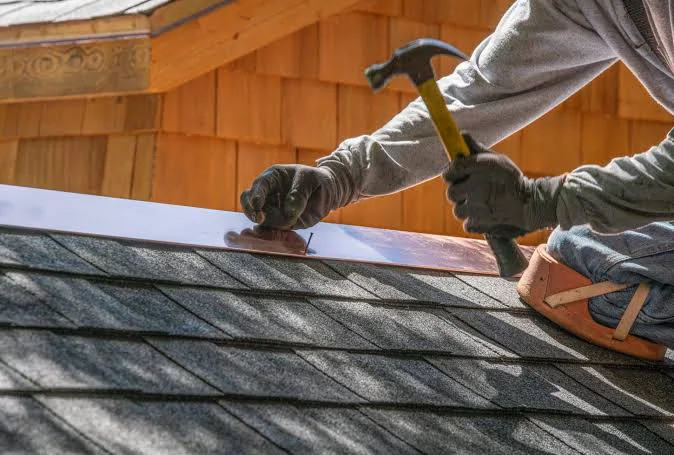
The explanation is that new roofs almost never leak through the covering. They leak at the junctions. Volume construction runs to a schedule, and the parts of a roof that take time and care are exactly the ones that can be rushed — step flashing installed one piece per shingle course, a counter-flashing let in properly, a kick-out fitted where a wall run meets the gutter, a pipe boot sealed at its base, nails driven inside the correct zone on each shingle. Every one of those is a small, skippable step, and skipping any of them produces a roof that passes a visual inspection and fails the first time it gets weather with real wind behind it. That is squarely flashing and shingle repair territory.
The terrain makes it worse here than in the older, sheltered parts of the city. This is open, relatively flat ground on the western edge of the metro, with far less mature tree cover than the creek corridors or the inner north side. Less shelter means more wind load on the roof plane, and wind is what exploits a marginal detail: it drives rain sideways under shingle courses, behind cladding at a sidewall, and past a counter-flashing that has lifted a couple of millimetres. If your leak only shows up when it is blowing, that is not a coincidence.
These faults also have a characteristic timeline. They do not leak immediately, because everything else is new and tight. They surface somewhere between year three and year ten, and they frequently appear in more than one place at once, because the same crew made the same omission on several details in a day. Settling whether that is what you are dealing with is the job of roof leak detection, and on this side of town it is the service that matters most. San Antonio roof leak repair explained has the wider picture.
The four services Far West Side homes need most
Recent construction on open ground produces a service mix built around diagnosis and detail work, not replacement.
Roof Leak Detection
Nothing up there looks wrong, which is precisely the problem. A directional water test against the elevation the weather hits is the only way to reproduce a wind-driven leak — a hose pointed down the slope will pass it every time and send you back to square one.
More on Roof Leak DetectionFlashing & Shingle Repair
Where almost every Far West Side leak ends up. Short step flashing, a missing kick-out, a surface-mounted counter-flashing or an unsealed boot base — each rebuilt as metal and woven into the courses so it works by lapping rather than by adhesive.
More on Flashing and Shingle RepairStorm & Hail Damage Repair
Open ground means wind damage as well as hail: creased shingles and sealant strips released along the leading edges, neither of which is visible from the ground once the wind drops.
More on Storm and Hail Damage RepairRoof Inspection
Worth doing on a newer home precisely because people assume it is unnecessary. If one detail was skipped there is a fair chance others were too, and finding them while they are still dry is considerably cheaper than finding them one storm at a time.
More on Roof InspectionA Far West Side roof checklist
Six things worth doing yourself, none of which require getting on the roof.
- Note whether it only leaks when the wind is up. On this side of town that single fact is the most diagnostic thing you can report.
- Dig out the builder paperwork before you book anybody. Structural and workmanship cover usually run on different clocks, and an outside repair can end one of them early.
- Follow every roof-to-wall line down to its bottom end. No small diverter throwing water into the gutter means no kick-out, and the damage goes inside the wall.
- Inspect the base of each vent pipe with binoculars for a collar that has cracked or lifted away from the pipe.
- Look along the leading edges after a windy day for shingles that lifted and did not lie back down flat.
- Shoot a dated set of all four elevations this month. On an exposed lot the next storm is the one that matters, and a before-picture is the one thing nobody can reconstruct afterwards.
Nearby areas we also cover
The Far West Side runs out past Loop 1604 toward the county line, with the rest of the west side behind it.
Immediately east toward the loop, where the housing is decades older and the problems are wear rather than workmanship.
Further in along the same corridor, dominated by 1970s to 1990s housing and shared roofs.
North on the I-35 corridor, with a near-identical growth profile and the same new-build failure pattern.
Out here the shingles are usually fine and a detail was skipped, which is a cheap repair if it is found properly. The heavy-rain guide explains why these leaks pass a standard hose test. the contact page is the quickest way to reach somebody.
Far West Side roof leak questions
My house is seven years old. Can the roof really be the problem?
Yes, and it is the most common scenario on this side of the city. Recent roofs leak at the junctions rather than through the field. A short piece of step flashing or an unsealed boot base will leak regardless of how new the shingles are, and it typically takes a few years plus a storm with wind behind it to show up.
Is this the builder's responsibility?
Possibly, and the paperwork decides it rather than we do. Builder cover in Texas is typically split — a short window on workmanship, a longer one on structure — so a seven-year-old roof may sit outside the part that would have covered flashing. Read the terms before you let anybody onto the roof, because an outside repair can close a door that was still open. If it is expired or does not apply, an independent contractor is the route.
Why does wind matter so much out here?
Because there is less in the way. The Far West Side is open ground with far less mature canopy and fewer tall structures than the inner city, so roofs take more direct wind load. Wind is what turns a marginal detail into a leak — it drives rain sideways and uphill into junctions that handle falling water perfectly well.
Should I get the whole roof checked or just the leaking area?
The whole roof, on a newer home especially. If one detail was skipped there is a reasonable chance others were too, by the same crew on the same day. Finding the second and third one now, while they are dry, costs far less than finding them one storm at a time.
Which ZIP codes does this cover?
The Far West Side runs across 78251, 78253, 78254, taking in Westover Hills, Alamo Ranch and the subdivisions out past Loop 1604. Every San Antonio ZIP we cover is listed on the service area page.