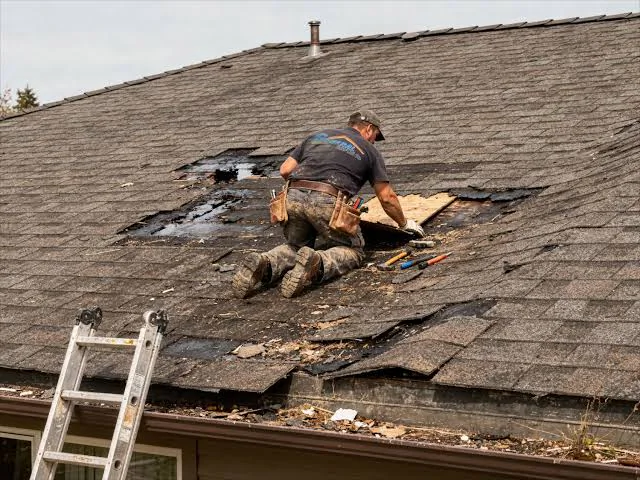
Ask a roofer in this city when they are busiest and you will get the same answer. Spring. The months either side of April bring the strongest convective storms of the year to South Central Texas, and with them the hail.
That is not news to anyone who has lived here. What is less obvious is that the work which protects a roof through that stretch happens months earlier, and that most of the damage a storm does will not be visible to you on the day it happens.
When the risky stretch actually is
Broadly, early spring through early summer, with the heart of it around March to May. That is when the atmosphere over this part of Texas most reliably produces the conditions severe storms need: warm moist air at the surface, colder air aloft, and enough instability and wind shear to build tall, organised storms.
Two caveats worth holding on to. First, this is a tendency rather than a schedule — a severe storm can happen outside that window and plenty of springs pass quietly. Second, and more usefully, hail is extremely local. Severe cells cross the metro on a line, so one neighbourhood takes a direct hit while the next one over gets ordinary rain. Across the north-east corridor through the north-east side this plays out every year, and the practical consequence is that city-wide reporting tells you very little about your own address.
Why spring and not the height of summer
It seems backwards. August is the most violent-feeling month here, so why is it not the hail month?
Because hail needs a storm that lifts water droplets high enough to freeze and holds them there long enough to grow, and that requires a particular combination of instability and cold air aloft. Spring supplies it: the surface is warming fast while the upper atmosphere is still cold from winter, which maximises the contrast that builds tall storms. By mid-summer the whole column has warmed, the freezing level is much higher, and storms that form tend to be intense but shorter-lived — producing heavy rain and wind rather than large hail.
Which is why San Antonio roofs face two separate seasonal problems rather than one. Spring brings impact damage. Summer brings sustained ultraviolet exposure and heat cycling that makes everything up there more brittle. The second makes the first worse the following year, and that compounding is the reason a ten-year-old roof here behaves like an older roof somewhere cooler.
A February checklist
None of this requires going on the roof. All of it is more useful done before the season than after.
- Clear the valleys and gutters. A restricted valley reaches its limit far faster in a downpour, and spring storms bring volume as well as stones.
- Trim anything overhanging the roof. Limbs that abrade in ordinary wind become limbs that break in a severe storm.
- Photograph every elevation from the same spot in the yard. Two minutes. This is the single most valuable thing on the list, and almost nobody has it when they need it.
- Check your soft metal now — vent caps, gutters, fascia wrap. Knowing what was already dented means you can tell what is new.
- Find your roof paperwork. Install date, product, any previous repair, and your insurance policy details, in one place you can find in a hurry.
- Book a pre-season look if the roof is over ten years old. A roof inspection before the season finds things while they are still cheap; the same visit in May is damage assessment.
Photograph the fins on your outdoor air-conditioning unit while they are undented, and again after any storm. Aluminium fins dent at impact energies well below what damages a roof, which makes them the most sensitive hail gauge most properties already own — and a before-and-after pair is far more persuasive than an after on its own.
What to do on the day
Stay inside, away from windows, and if it is safe from a doorway, film the hail falling next to something of known size — a coin on the step, a tape measure on the sill. Stone size at your specific address is the one detail nobody can reconstruct afterwards, and it is the detail most often disputed.
Note the time and roughly how long it lasted. If anything starts coming in during the storm, that is a different situation and it is covered by emergency roof leak repair — containment first, roof work when it is safe.
The week after
Here is the part people get wrong, and it is worth being blunt. A roof can be seriously damaged by hail and not leak at all.
What an impact does is fracture the fibreglass mat inside the shingle, so it can no longer flex through the daily heat cycle without splitting along that line, and knock off the granule layer that shields the asphalt from the sun. Neither effect necessarily opens a path for water on the day. Both put the roof on a shorter clock. The leak arrives a year or two later, by which point the storm is a distant memory and it looks like ordinary ageing.
So the week after a storm, walk the perimeter with a camera rather than waiting to see whether anything drips. Gutters, downspouts, fascia, screens, the condenser, and every slope through binoculars. Then get it assessed properly — a storm and hail damage assessment is built around separating functional damage from cosmetic marking, slope by slope, while the cause is still recent enough to attribute.
And take the usual precautions with anybody who knocks on the door that week. Door-knocking after a storm is routine here and not automatically a problem, but ask for a licence and certificate of insurance, get the scope in writing, never sign anything assigning an insurance claim, and ask to be shown the damage in photographs rather than simply told it exists.
The cost of waiting a season
The argument for acting in the weeks after a storm rather than the following year comes down to three things.
Attribution gets harder. Damage from different events overlaps, normal weathering blurs the marks, and foot traffic from other trades adds its own. A roof assessed within weeks has a clean story; the same roof assessed two years on does not.
The roof enters the next season weaker. Fractured shingles do not heal. A roof carrying mat damage through a summer of ultraviolet exposure and then into the following spring is starting from a materially worse position than it was in.
Everyone is busy at once. A concentrated hail event books out the competent contractors in the affected areas quickly, which is also what draws out-of-town crews. Being early in that queue is worth something on its own.
If you want the full picture of how roof problems get found and fixed across the city, roof leak repair in San Antonio, TX is the place to start, and roof tarping is what to do if the storm has already left you with water coming in.
Hail season questions
Does San Antonio only get hail in spring?
No, but spring is when the conditions that produce damaging hail line up most reliably. Severe thunderstorms can occur outside that window, and an isolated autumn storm can certainly drop stones. What spring brings is the combination — strong instability, moisture and the temperature contrasts that build the tall storm structures hail needs — happening repeatedly rather than occasionally.
How big does hail have to be to damage a roof?
There is no single threshold, which frustrates people. It depends on stone hardness and shape, fall speed, wind driving it in at an angle, and crucially the condition of the roof it lands on. A shingle ten years into a run of Texas summers has lost flexibility and bruises at impacts a new roof would shrug off. That is why two neighbours can get the same storm and genuinely different results.
Should I get my roof inspected every spring?
An annual look is reasonable in this climate regardless, and timing it before the season rather than after is the more useful choice. Pre-season you are finding things while they are cheap and while there is time to act. Post-season you are assessing damage. Both have value; only one of them prevents anything.
Is it worth doing anything if my roof is nearly due for replacement anyway?
Arguably more, not less. A roof already near the end of its life has the least margin left, so it takes the worst of a storm and it is the most likely to start leaking afterwards. Knowing its condition before the season means you make the replacement decision on your own schedule rather than during a week when every roofer in the city is booked.
My roof came through last spring fine. Does that tell me anything?
Only that last spring's storms missed you or were mild where you are. Severe cells track across the metro on a line rather than covering it evenly, so coverage varies enormously by neighbourhood and even by street. A clean record last year is not a forecast for this one, and a roof a year older has slightly less margin than it did.
Keep reading
Before or after the season, these are the practical next steps.