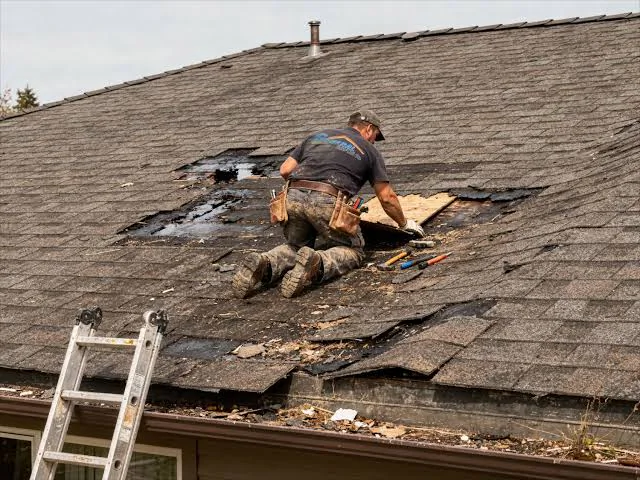
What to do in your Stone Oak home while you wait
Work down this list in order. On a two-storey Stone Oak house the ceiling you are protecting may be a long way below where the water got in, so the inside work matters more here than on a single-storey roof.
- Find the lowest point it is reaching
On a two-storey house water can enter upstairs and surface downstairs. Walk the whole house before you set a bucket, including the garage and any room under a valley.
- Protect the staircase and anything wooden
Hardwood and engineered flooring on a landing takes permanent damage fast. Towels and a plastic sheet under the drip zone buy you hours.
- Kill the circuit, not just the light switch
Recessed fittings are the usual route into a Stone Oak ceiling. Switch that circuit off at the breaker and leave it off until somebody confirms the area is dry.
- Relieve a sagging ceiling before it lets go
Pierce the lowest point of the bulge with a screwdriver and put a bin under it. A loaded ceiling over a two-storey stairwell is not something to leave until morning.
- Photograph the roof from the yard, not the roof
Wide shots of each elevation from the ground, with the time. On a steep pitch this is the only safe record you can make tonight, and it is genuinely useful tomorrow.
- Call and say the roof is steep and two-storey
It changes the crew and the equipment sent. A 10:12 pitch in the wet needs fall protection, and saying so up front avoids a wasted visit.
Why height works against you here
On a single-storey house, water that gets past the roof has a short trip to the ceiling. On a Stone Oak two-storey it has options. It lands on the decking, runs down to a rafter, tracks along it, and can drop into the floor cavity between storeys rather than through a ceiling at all. That cavity holds a remarkable amount before anything shows, and what finally appears downstairs may be twenty feet from where it entered.
The practical consequence is that the visible drip understates the problem on these houses more than on most. By the time a downstairs ceiling is marked, the subfloor above it has usually been wet for a while. That is why the inside work matters so much tonight — and why a proper leak detection visit afterwards is not optional on a house with this much structure between the roof and the room.
Why a weighted tarp fails on a steep slope
A tarp held down by bricks works, barely, on a shallow roof. On a 10:12 Stone Oak pitch it does not work at all. Gravity pulls the whole sheet downslope, the weights slide, and the open top edge funnels water underneath it — so the wetted area ends up larger than the leak it was meant to cover. Wind at this elevation finishes the job by lifting the sheet and taking shingles with it.
What holds on a steep roof is a tarp carried up over the ridge and secured on the opposite slope, so there is no edge facing uphill anywhere, with timber battens fastened through the sheet into the decking to spread the load. That is a crew job with fall protection, not something to attempt off a ladder in the rain.
What comes up most on Stone Oak emergency calls
Stone Oak emergency calls have a pattern, and it follows from the housing. These are large, steep, articulated roofs on houses mostly built between the early 1990s and the 2010s, so the covering is rarely the thing that failed. What fails is a junction, and under a hard downpour the junction that fails is nearly always a valley.
A Stone Oak elevation can carry eight or more valleys, each collecting water off two large planes and funnelling it into a channel a couple of feet wide. That channel has a capacity. In an ordinary rain it is never tested. In the short, violent downpours this region actually gets, it backs up, rises above the shingle edges either side and goes in sideways — with nothing visibly wrong anywhere on the roof.
The second pattern is wind at elevation. The far north sits high and exposed on the Hill Country fringe, and spring cells track across it with real wind ahead of the rain. That lifts shingles whose sealant strips have aged, strips ridge caps, and drives water under courses on the elevation facing the weather. A house that has never leaked can leak for the first time in one evening.
The third is access, and it changes what can be done tonight rather than what went wrong. A 10:12 pitch at two storeys in the wet is not a roof anybody should be walking without fall protection, so on a steep Stone Oak elevation the honest emergency answer is often containment inside and a properly battened dry-in at first light, rather than a heroic repair in the dark.
What drives the cost of an emergency call in Stone Oak
Pitch and height drive the figure here more than anything else, and no honest quote exists before somebody has seen the roof. These are the variables a Stone Oak emergency call is actually priced on.
| Variable | Effect on the job |
|---|---|
| Time of day and weather | After-hours work in active weather needs more people, more lighting and slower, more careful movement. |
| How much roof has to be covered | A single failed penetration is a small cover. A storm-stripped slope may need the whole plane carried over the ridge. |
| Pitch, height and access | Steep or two-storey slopes need fall protection and change the crew size required. |
| Interior work needed first | Containment, relieving ceilings and protecting contents is real labour before anybody reaches the roof. |
| Whether a point repair is possible | An accessible, obvious failure fixed on the spot avoids both the tarp and the second visit. |
| Decking condition once it is opened | Soft sheathing turns a covering repair into carpentry, and it is rarely visible until the shingles come off. |
Emergency roof leak questions, Stone Oak
My roof is fifteen years old and it has never leaked. Why tonight?
Almost certainly because tonight exceeded a threshold rather than because something finally wore out. A valley that has handled every rain for fifteen years has a maximum flow rate, and a short violent downpour can exceed it. The same goes for wind: a sealant strip that has quietly aged holds until a gust gets under the course. Neither leaves anything visibly broken, which is why these calls are so often followed by a clean-looking roof.
Can anything be done on a steep two-storey roof in the dark?
Containment inside, always. On the roof it depends on the pitch, the wind and the surface. A crew with fall protection can dry in a reachable section at night; a 10:12 in active rain is a different proposition and the right answer may be to protect the interior and cover it at first light. Anybody who promises a full repair on a steep wet roof at midnight is overselling.
Water is coming in near a recessed light. Is that dangerous?
Treat it as electrical until proven otherwise. Recessed fittings are holes in the ceiling, so water finds them, and it runs along cable. Switch the circuit off at the breaker and leave it off until somebody confirms the area is dry. If water is visibly coming out of the fitting or you see or smell anything electrical, kill the main and call an electrician.
Which Stone Oak ZIP codes does this cover?
78258, 78259, 78260, 78261, taking in Sonterra, Cibolo Canyons and the far north generally. If you are just outside those, say your cross street on the call.
Should I file a claim before or after the emergency work?
Get the water stopped first — no insurer expects you to let a house flood while paperwork moves, and emergency mitigation is normal. Photograph everything before and during. We are a referral service and cannot advise on your policy, so the claim conversation is between you and your insurer, but the documentation a contractor produces on the night is what it will rest on.
Other roof services in Stone Oak
Once the roof is dry, the Stone Oak question is almost always which junction failed rather than whether the covering is finished. Leak detection pins it, and flashing repair rebuilds the detail in metal so it stops happening.